
Reading Time: 4 minutes
“Someone has suggested that we pulpiteers should think of ourselves as coming in fourth place. When it comes to importance, the Divine Composer of the message ranks first, then the message, and next the people to whom it is sent. We messengers, come in a lowly fourth.” – page 26
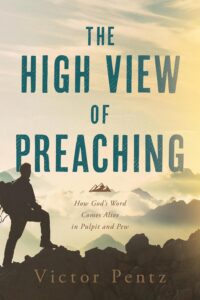
I was perusing the latest issue of Christianity Today when I spotted a full-page advertisement for The High View of Preaching by Victor Pentz. I try to read at least two books on preaching every year, so I figured I was due. Then I found out I could get it free through Kindle Unlimited! The price was right!
I was curious to see whether it would offer anything genuinely new.
In many ways, it didn’t.
And that’s precisely why it’s worth reading.
Recovering a “High View”
Victor Pentz argues that much of modern preaching has drifted toward what he calls a “low view” of preaching—a view that treats the sermon as a persuasive speech delivered by a gifted communicator to passive listeners. Against that, he proposes a “high view”: preaching is a supernatural event in which the risen Christ speaks through the faithful proclamation of Scripture by the power of the Holy Spirit.
Whether you agree with every aspect of his argument or not, that conviction permeates every chapter of the book. Pentz repeatedly reminds preachers that they are not ultimately responsible for producing spiritual transformation. God is the primary actor in the preaching event. The preacher’s task is faithfulness.
That is a message many pastors need to hear.
“The high view [of preaching] offers four soul-reviving assumptions. The sermon is: an encounter with the Risen Christ by a flawed and human preacher to active and engaged hearers that relies on the Holy Spirit to transform lives.” – page 22
Less a Professor, More a Mountain Guide
One of Pentz’s greatest strengths is that he writes less like a seminary professor and more like a seasoned mountain guide. Mountain climbing becomes the controlling metaphor of the book (and it’s one of his loves). The goal isn’t simply to master better homiletical techniques but to keep climbing toward a higher vision of preaching. Pentz isn’t trying to impress readers with originality. He wants to encourage weary pastors to keep ascending, trusting that God is doing far more in the preaching event than they often realize.
It’s the kind of book any preacher would be able to write after a long and faithful life of service.
That perspective gives the book tremendous warmth. Pentz shares stories from decades of ministry—from leading devotions for astronauts before launch to climbing Mount Rainier to his surprisingly memorable reflections on making the perfect Caesar salad. None of these stories feel self-indulgent. They illustrate lessons learned through years of faithful ministry rather than classroom theory.
Practical Wisdom from a Lifetime of Ministry
The book is exceptionally well organized. Every chapter begins with the letter “P”—Performance, Persuasion, Presence, Partnership, Preparation, Person, Pinnacle, and Perspective. At times the alliteration feels a little forced, but the structure works. In fact, nearly every chapter could serve as the outline for a pastors’ conference or seminary workshop.
The chapter on sermon preparation is particularly strong. Pentz offers practical wisdom on planning ahead, crafting a unified sermon theme, cultivating curiosity, reading broadly, and becoming the kind of interesting person who naturally accumulates meaningful stories. Throughout the book, he demonstrates that he is also a well-read preacher, drawing naturally from voices such as Augustine, Calvin, Tim Keller, Jonathan Haidt, and many others. More than once I found myself adding another title to my own reading list.
One Reservation
If I have one significant reservation, it concerns the central contrast between the “high view” and the “low view” of preaching.
The “high view” is compelling. The “low view,” however, sometimes feels more like a rhetorical foil than a position many preachers would consciously embrace. I know very few pastors who would intentionally describe preaching as merely giving a speech about God. Most already believe God works through His Word, even if they sometimes carry more of the burden themselves than they should. The contrast is effective, but at times it risks oversimplifying the issue in order to strengthen the argument.
That criticism, however, doesn’t diminish the book’s overall value.
Come for Inspiration More Than Information
Readers looking for groundbreaking homiletical theory may leave disappointed. That isn’t Pentz’s goal. This is not primarily a book about how to preach but why preaching matters.
Come to The High View of Preaching less for new information than for renewed inspiration. Pentz serves as an experienced guide, reminding preachers why they began climbing the mountain in the first place and encouraging them to keep climbing.
And whatever you do, don’t skip the appendices. They are full of beautiful prayers for the preacher, the sermon, and the hearers. They beautifully embody the spirit of the entire book and are worth returning to long after you’ve finished the final chapter.
Nicolaus Ludwig von Zinzendorf is often credited with saying, “Preach the gospel, die, and be forgotten.” As I closed this book, I couldn’t help but think that those words describe not only the kind of preacher Pentz hopes to shape, but the kind of preacher he himself has become.
“I breathed an amen when I heard one famous preacher say, ‘To be a preacher is every week to die naked publicly.'” – page 24